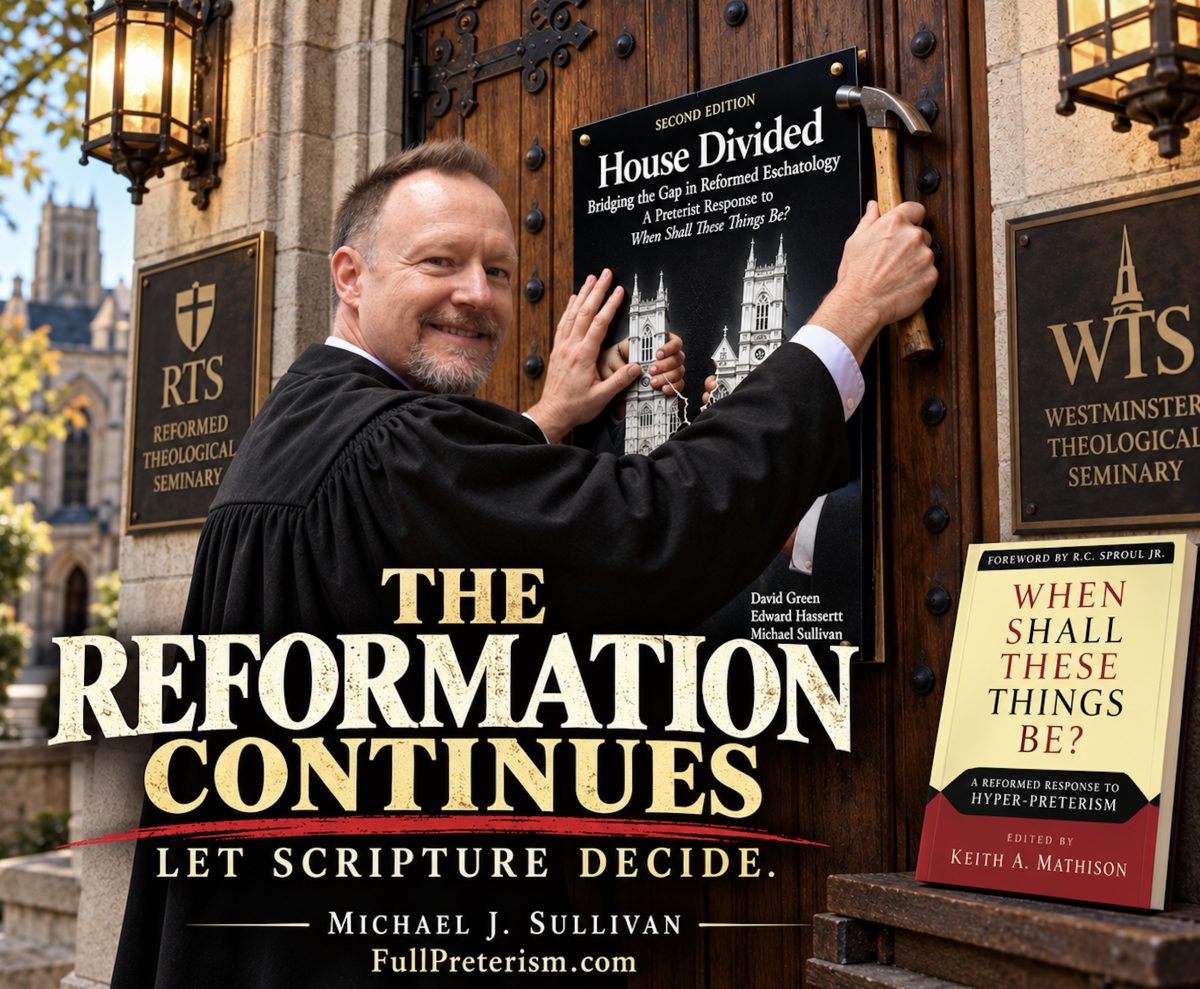
I. Is Another Reformation Needed in Eschatology?
As we commemorate the Protestant Reformation, I want to address the faculty, administration, students, and graduates of Reformed Theological Seminary (RTS) and Westminster Theological Seminary (WTS) concerning a question that deserves serious consideration: Is another reformation needed in eschatology? I am not asking the Reformed community to abandon the sovereignty of God, the doctrines of grace, or the authority of Scripture. I am asking whether the same commitment to sola Scriptura that compelled Martin Luther to challenge the theological establishment should compel us to examine the unresolved contradictions within Reformed eschatology.
The Protestant Reformation was not founded upon the assumption that the Church had always interpreted every doctrine correctly. Luther recognized that respected theologians, popes, councils, and ecclesiastical institutions could err and contradict one another. At the Diet of Worms in 1521, he appealed to Scripture and clear reason rather than submitting his conscience to conflicting ecclesiastical authorities. The principle was straightforward: no human tradition, however ancient or respected, possesses authority over the inspired Word of God. If we genuinely believe that principle, then the Westminster Confession, our theological institutions, and our eschatological traditions must remain subject to biblical examination.
I write as a Sovereign Grace Christian committed to Sovereign Grace and the complete redemptive work of Jesus Christ. I also write as a full preterist who believes that the second coming of Christ, the resurrection, the judgment of the living and the dead, and the consummation of the new covenant kingdom were fulfilled at the end of the old covenant age in AD 70. I recognize that this conclusion challenges the eschatological standards maintained by RTS, WTS, and much of the Reformed community. But the question is not whether full preterism agrees with every inherited confessional formulation. The question is whether those formulations consistently harmonize the teaching of Scripture.
Jesus declared that His coming in judgment would occur within the lifetime of some of those standing before Him (Matt. 16:27–28). He connected the destruction of Jerusalem, the end of the age, the abomination of desolation, the great tribulation, His coming upon the clouds, and the gathering of His elect with events that would occur before His contemporary generation passed away (Matt. 24:3–34). Paul announced that the night was far spent and the day was at hand (Rom. 13:11–12). Peter declared that God was ready to judge the living and the dead, that the end of all things was near, and that the appointed time had come for judgment to begin at the house of God (1 Pet. 4:5–7, 17). John was commanded not to seal Revelation because the appointed time was near (Rev. 22:10). These inspired time statements establish the framework within which the eschatological consummation must be understood.
My central argument is that Reformed eschatology has become a house divided against itself. Classic amillennialism correctly defends the unity of the second coming, resurrection, judgment, and consummation. Partial preterism correctly recognizes the first-century fulfillment of substantial portions of New Testament prophecy. Yet these systems remain divided because neither consistently incorporates the strongest biblical conclusions of the other. I am not introducing a new revelation or inventing an entirely new set of theological premises. I am asking the Reformed community to harmonize truths its own theologians have already acknowledged.
II. Luther, John Lightfoot, John Owen, and the Unfinished Reformation
Luther’s confrontation with John Eck and the ecclesiastical establishment demonstrated that doctrinal reform requires the courage to examine inherited theological traditions. It is easy to celebrate Luther five centuries after the fact. It is more difficult to practice the same principle when the disputed doctrine concerns the theological commitments of our own institutions. Yet the Reformation cannot become a historical monument that prevents further reform. The Church must continually examine whether its doctrines faithfully represent the teaching of Scripture.
The Reformed tradition itself has supplied important foundations for a covenantal understanding of biblical eschatology. John Lightfoot recognized the first-century fulfillment of significant portions of Matthew 24 and understood the creation in Romans 8 in relation to the creation of men rather than merely the physical universe. His observations were especially important to my own theological development because they encouraged me to examine Paul’s corporate and covenantal language concerning the revealing of the sons of God and the redemption anticipated by the first-century Church.
Romans 8:18–23 must also be read in light of Paul’s temporal language. In Romans 8:18, the Greek construction involving mellō points toward the glory that was about to be revealed, as reflected in Young’s Literal Translation. Paul describes the creation and believers as eagerly awaiting the revealing of the sons of God and the redemption of the body. These expectations must be harmonized with his declarations that the day was near and that the appointed time had been shortened (Rom. 13:11–12; 1 Cor. 7:29–31). The question is whether Paul anticipated the approaching consummation of new covenant redemption or a physical transformation of the planet thousands of years later.
John Owen likewise recognized the covenantal significance of the passing of the heavens and earth in connection with the removal of the Mosaic economy. His interpretation of 2 Peter 3 associated the dissolution of the old heavens and earth with the passing of the Jewish church and state rather than requiring the annihilation of the physical cosmos. This interpretation has a strong Old Testament foundation. In Isaiah 51:9–16, the Lord describes His redemption and formation of Israel through creation language, declaring that He planted the heavens, laid the foundations of the earth, and said to Zion, “You are My people.” The heavens and earth could therefore describe a covenantal order established by God.
Hebrews develops the same theme. The first covenant was becoming obsolete and was ready to vanish away (Heb. 8:13). The writer announced an approaching shaking and removal of what could be shaken so that the unshakable kingdom would remain (Heb. 12:26–28). The Church was receiving that kingdom, not waiting for the physical destruction of the universe before Christ could reign. The passing of the old heavens and earth and the establishment of the new creation must therefore be understood in relation to the covenantal transformation occurring between the cross and the destruction of Jerusalem in AD 70.
These observations were not confined to Lightfoot and Owen. Modern Reformed theologians such as Kenneth Gentry, Keith Mathison, Douglas Wilson, James Jordan, and Peter Leithart have contributed in different ways to discussions concerning the first-century fulfillment of prophecy, covenantal judgment, and the relationship between Jerusalem’s destruction and New Testament eschatology. I do not claim that these scholars agree with full preterism or with one another on every issue. My point is that significant premises supporting a first-century and covenantal interpretation are already present within Reformed scholarship. The question is whether those premises have been consistently harmonized.
III. R. C. Sproul, the Fear of Man, and the Courage to Follow Scripture
R.C. Sproul deserves recognition for his contributions to Reformed theology and his willingness to challenge popular futurist interpretations of biblical prophecy. In The Last Days According to Jesus, Sproul took seriously the first-century time statements of Christ and His apostles and recognized the profound eschatological significance of Jerusalem’s destruction in AD 70. He understood that the credibility of Jesus’ prophetic claims was at stake when interpreters postponed events Christ had declared would occur within His generation.
Nevertheless, Sproul stopped short of the full-preterist conclusion. He maintained a future bodily resurrection, final judgment, and consummation while recognizing the first-century fulfillment of important passages concerning Christ’s coming. This raises the same question that confronts partial preterism generally: If Jesus’ coming in Matthew 24 was fulfilled in AD 70, what biblical warrant requires us to divide that coming from the one eschatological coming defended by classic amillennialism?
Pastor David Curtis has recounted a direct conversation with R. C. Sproul in which he specifically asked Sproul why he was not a full preterist. According to Curtis, Sproul responded by referring to the number of people whose employment depended upon him and his ministry. This was not merely Curtis speculating about Sproul’s motives; he was reporting Sproul’s own response to a direct question. Although I recognize that we are relying upon Curtis’s firsthand recollection rather than a recorded transcript, the significance of the exchange should not be overlooked. Sproul’s reported answer raises a serious question about the institutional and financial pressures that can influence theological decisions, particularly when pastors, professors, and ministry leaders recognize the potential consequences of challenging established confessional boundaries. I cannot claim to know everything Sproul believed privately or precisely what he intended by his response. Nevertheless, the question remains: Should concerns about institutional stability, financial support, or the employment of others prevent Reformed theologians from following the biblical evidence wherever it leads? If the Reformation taught us anything, it is that Scripture must take precedence over institutional security and ecclesiastical tradition.
Proverbs 29:25 declares, “The fear of man brings a snare, but whoever trusts in the LORD shall be safe” (NKJV). That warning applies to all of us. The temptation to preserve reputation, institutional security, financial support, or professional relationships can make it difficult to follow an exegetical argument to an unpopular conclusion. Reformed institutions should therefore cultivate an environment in which difficult biblical questions can be examined without automatically equating disagreement with disloyalty to the Reformed faith. The legacy of Sproul’s contribution to preterist interpretation should encourage further investigation rather than establish an arbitrary stopping point.
IV. Fifteen Centuries to Clarify Justification: Why Not Continue the Reformation in Eschatology?
The historical development of Christian doctrine presents another important argument. Reformed theologians have acknowledged that eschatology has not always received the same sustained attention and systematic development as other areas of Christian theology. If that is true, why should we assume that the eschatological formulations inherited from the Westminster divines represent the final stage of the Church’s understanding? Why should we recognize substantial developments in the doctrines of the Trinity, Christology, justification, and salvation while insisting that our understanding of the second coming, resurrection, judgment, and new heavens and earth cannot undergo similar biblical correction?
Consider the doctrine of forensic justification. Approximately fifteen centuries passed between the apostolic proclamation of justification by faith and the Protestant Reformation’s decisive clarification of the doctrine. We are frequently told that forensic justification was taught before Luther, and undoubtedly certain earlier theologians employed language concerning grace, faith, and righteousness that anticipated elements of the Reformation. But when we examine many of the passages offered as evidence, justification is often intertwined with sanctification, infused righteousness, obedience, and participation in the sacraments. What is considerably more difficult to establish is that these writers consistently taught the distinctly Protestant doctrine of justification as a forensic declaration grounded exclusively in the imputed righteousness of Christ and received through faith alone. Merely finding the vocabulary of justification before Luther does not demonstrate that the earlier Church articulated the doctrine in the same way the Reformers did.
Paul had already taught that God justifies the ungodly and that righteousness is reckoned apart from works (Rom. 3:21–28; 4:4–8; Gal. 2:16). The apostolic doctrine was present in Scripture from the beginning, but the Church’s understanding and articulation of it required substantial correction during the sixteenth-century Reformation. Luther was not introducing a new revelation. He was recovering, clarifying, and consistently applying what the apostles had already taught. If Reformed theologians celebrate Luther for challenging approximately fifteen centuries of ecclesiastical tradition concerning justification, they should be particularly cautious about rejecting further eschatological reformation merely because the Church has not historically embraced its conclusions.
What makes the eschatological question especially significant is that early Christian writers acknowledged the fulfillment of several important prophetic signs associated with the end of the age. John Chrysostom understood the preaching of the gospel throughout the world in Matthew 24:14 as a first-century accomplishment preceding Jerusalem’s destruction. He appealed to Paul’s declaration that the gospel had been preached to every creature under heaven (Col. 1:23) and interpreted the abomination of desolation in relation to the Roman destruction of Jerusalem and the temple. Thus, Chrysostom recognized the first-century fulfillment of two principal signs Jesus identified in the Olivet Discourse, even though he did not consistently extend that interpretation to the consummation of Christ’s coming.[1]
Eusebius of Caesarea likewise interpreted Daniel’s seventy weeks in connection with the coming of Christ, the establishment of the new covenant, and the destruction of Jerusalem and its temple. In his Demonstration of the Gospel, Eusebius understood Daniel 9:24–27 as announcing the removal of Mosaic worship and the introduction of the new covenant. He did not postpone the seventy weeks to a distant future involving a rebuilt temple. Although he did not formulate the full-preterist interpretation I defend, his testimony demonstrates that Daniel’s prophecy was understood as fulfilled in connection with Christ and the first-century transition from the old covenant to the new.[2]
These admissions raise an important question. If the gospel was preached throughout the Roman world before AD 70, if the abomination of desolation was fulfilled through the Roman armies, and if Daniel’s seventy weeks were fulfilled in connection with Christ and Jerusalem’s destruction, why should the coming of the Son of Man associated with those events be postponed thousands of years? Jesus declared that the signs, the tribulation, His coming upon the clouds, and the gathering of the elect belonged to the events that would occur within His generation (Matt. 24:29–34). The early Fathers recognized important elements of that fulfillment without consistently bringing those elements together.
V. Origen, Kenneth Gentry, and the Divorce of Israel: The Marriage, Resurrection, and New Creation in AD 70
There is another remarkable admission from the early Church that deserves the attention of RTS and WTS. Origen, writing in the third century, explicitly connected God’s divorce of unfaithful Israel, His reception of another through the new covenant, and the destruction of Jerusalem and its temple. In his Commentary on Matthew, Book XIV, chapter 19, entitled “The Divorce of Israel,” Origen understood Jerusalem’s destruction as the historical evidence that God had issued a covenantal bill of divorce to His former wife. He described God as having “married, so to speak, another” and identified the destruction of Jerusalem and the cessation of temple worship as evidence that the former covenant relationship had been terminated.[3]
Origen was not a full preterist, and I am not suggesting that he consistently connected this conclusion with the fulfillment of every eschatological promise. My argument is that he recognized an important covenantal premise: the destruction of Jerusalem in AD 70 signified God’s divorce of His former covenant wife and the establishment of another covenantal relationship. This interpretation did not originate with modern full preterists. The question is whether the covenantal divorce and marriage acknowledged by Origen can be consistently reconciled with the timing of the resurrection, judgment, and new creation.
What makes this argument even more significant is that Kenneth Gentry, a prominent Reformed partial preterist and critic of full preterism, has developed essentially the same covenantal framework. In his interpretation of Revelation, Gentry identifies the seven-sealed scroll with God’s divorce decree against old covenant Israel and connects the execution of that judgment with AD 70. He interprets the judgment of the harlot Babylon as the judgment of unfaithful Jerusalem and identifies the new Jerusalem of Revelation 21–22 with the new covenant Church, the bride of Christ. He further recognizes that the new heavens and new earth symbolize the establishment of the new covenant order. Thus, Gentry acknowledges that Revelation describes the removal of the old covenant wife and the presentation of the new covenant bride in connection with the first-century destruction of Jerusalem.[4]
But this creates a significant problem for partial preterism. Revelation does not describe the judgment of the harlot, the marriage of the Lamb, the judgment of the dead, and the new heavens and new earth as unrelated theological themes that can be separated by thousands of years without careful exegetical justification. Revelation 19 announces that the marriage of the Lamb has come and that His wife has made herself ready. Revelation 20 describes the resurrection and judgment, the destruction of Death and Hades, and the removal of the former order. Revelation 21 then presents the new heavens and new earth and the new Jerusalem descending from heaven as a bride adorned for her husband. If the marriage of the Lamb and the arrival of the new Jerusalem belong to AD 70, why should the resurrection and defeat of death associated with that consummation be postponed thousands of years into our future?
Isaiah 25 supplies an especially important connection. The chapter begins with the judgment of a fortified city that God has made a heap and a ruin (Isa. 25:1–2). Within that same prophetic context, the Lord prepares a great feast for all peoples upon His mountain, removes the covering spread over the nations, swallows up death forever, wipes away tears, and brings the promised salvation for which His people have waited (Isa. 25:6–9). The judgment of the city and the celebration of salvation belong to the same prophetic vision. The feast is not restricted to ethnic Israel but includes all peoples, anticipating the inclusion of the Gentiles in the blessings of the new covenant kingdom. The overthrow of the city and the defeat of death form part of the same redemptive triumph.
The identification of the ruined city in Isaiah 25:2 with old covenant Jerusalem must be established through the broader covenantal and New Testament context rather than assumed from that verse alone. But once the connections between Isaiah’s judgment imagery, the destruction of Jerusalem, and the new covenant feast are recognized, the implications become significant. Jesus described the kingdom through the imagery of a wedding feast and warned that the city of those who rejected the invitation would be destroyed (Matt. 22:1–14). He also announced that many would come from east and west to sit down with Abraham, Isaac, and Jacob in the kingdom while the sons of the kingdom would be cast out (Matt. 8:11–12). These are covenantal themes of judgment, exclusion, Gentile inclusion, and the establishment of the messianic kingdom.
Paul removes any doubt that Isaiah 25 is also a resurrection prophecy. In 1 Corinthians 15:51–54, he describes the resurrection transformation at the last trumpet and explicitly quotes Isaiah 25:8 concerning death being swallowed up in victory. Paul directly identifies Isaiah’s promised defeat of death with the resurrection consummation anticipated by the first-century Church. Consequently, Isaiah 25 brings together the judgment of a city, the messianic feast for all peoples, the removal of death, and the salvation of God’s people. Revelation 19–21 brings together the judgment of Babylon, the marriage supper of the Lamb, the resurrection and judgment, the destruction of Death and Hades, and the arrival of the new Jerusalem. These prophetic connections demand a consistent explanation.
The challenge to Gentry and other partial preterists is therefore straightforward. If the divorce of old covenant Israel occurred in AD 70, if the marriage of the Lamb and presentation of the new Jerusalem are associated with that same covenantal transition, and if the new heavens and new earth symbolize the arrival of the new covenant order, what exegetical basis requires us to remove the resurrection and final defeat of death from that consummation? Isaiah 25 connects the judgment of the city, the feast for the nations, and the swallowing up of death. Paul identifies that defeat of death with the resurrection. Revelation connects the marriage of the Lamb, the resurrection and judgment, the destruction of Death and Hades, and the new creation. These connections cannot be dismissed merely because their consistent application challenges the traditional futurist understanding of resurrection.
This is precisely the kind of theological harmonization that I believe remains unfinished within Reformed eschatology. Origen recognized that the destruction of Jerusalem signified God’s divorce of His former covenant wife and His reception of another. Gentry recognizes that Revelation presents the divorce of old covenant Israel and the marriage of the new covenant Church in connection with AD 70. Classic amillennialism recognizes the unity of the resurrection, judgment, defeat of death, and consummation of the new creation. Paul explicitly connects the resurrection with Isaiah’s prophecy of the defeat of death, while Revelation places the marriage of the Lamb, the judgment, and the new Jerusalem within its announced framework of imminent fulfillment. I am not introducing a new eschatological premise. I am asking the Reformed community to harmonize the biblical conclusions that its own theologians have already acknowledged.
VI. House Divided: Four Syllogisms That Reconcile Classic Amillennialism and Partial Preterism
In House Divided: Bridging the Gap in Reformed Eschatology, David Green, Edward Hassertt, and I responded to the arguments presented in When Shall These Things Be? A Reformed Response to Hyper-Preterism, edited by Keith Mathison. Our central argument was that classic amillennialism and partial preterism each preserve important biblical truths but fail to harmonize them consistently. Classic amillennialism correctly maintains the unity of Christ’s coming, the resurrection, the judgment, and the consummation of the new creation. Partial preterism correctly recognizes the fulfillment of significant New Testament prophecies in connection with Jerusalem’s destruction in AD 70. When these conclusions are consistently brought together, they establish the biblical foundation for full preterism.
I am not asking RTS and WTS to abandon Reformed theology. I am asking them to examine whether the conclusions of their own theologians, when consistently harmonized with Scripture, require a more complete reformation of eschatology. The following four syllogisms summarize that challenge.
First Syllogism: The One Coming of Christ
Major Premise (Classic Amillennialism): Scripture teaches one eschatological coming of Christ in glory, associated with the consummation of the age, the judgment, and the full manifestation of His kingdom.
Minor Premise (Partial Preterism): The coming of Christ described in Matthew 24:27–34 was fulfilled in connection with Jerusalem’s destruction in AD 70, within the generation to which Jesus spoke.
Conclusion (Full Preterism): If Scripture teaches one eschatological coming of Christ, and the coming described in Matthew 24 was fulfilled in AD 70, then the one eschatological coming of Christ was fulfilled in AD 70.
Jesus described His coming upon the clouds in Matthew 24:30 and then described the Son of Man coming in glory and sitting upon His throne in Matthew 25:31. Both passages draw upon Daniel 7, where the Ancient of Days sits in judgment, the Son of Man receives everlasting dominion, and the saints inherit the kingdom (Dan. 7:9–14, 22). In the Old Greek version of Daniel 7:13, the Son of Man comes “as the Ancient of Days,” further emphasizing His participation in divine judgment and authority. Matthew 24–25 presents complementary descriptions of the same coming, not two eschatological comings separated by thousands of years. Jesus explicitly placed these events within His contemporary generation (Matt. 24:34). If partial preterism correctly recognizes the AD 70 fulfillment of Matthew 24, why does it separate Matthew 25 from that same coming and judgment?
Second Syllogism: The One Judgment of the Living and the Dead
Major Premise (Classic Amillennialism): Scripture teaches one eschatological judgment of the living and the dead, associated with Christ’s appearing and kingdom (Matt. 25:31–46; 2 Tim. 4:1; Rev. 11:18).
Minor Premise (Partial Preterism): The apostles announced that the judgment associated with the end of the age was imminent in the first century. Peter declared that God was ready to judge the living and the dead, that the end of all things was near, and that the appointed time had come for judgment to begin at the house of God (1 Pet. 4:5–7, 17).
Conclusion (Full Preterism): If Scripture teaches one eschatological judgment of the living and the dead, and the apostles announced that this judgment was ready and near in the first century, then that judgment belongs to the consummation of the old covenant age in AD 70.
Peter does not merely announce an approaching political judgment against Jerusalem. He identifies the judgment as that of the living and the dead and connects it with the approaching end and the appointed time of judgment. Paul likewise describes Christ as the one who was “about to judge” the living and the dead in connection with His appearing and kingdom (2 Tim. 4:1, YLT). Revelation 11:18 places the judgment of the dead, the rewarding of the prophets and saints, and the destruction of those who destroy the earth within the sounding of the seventh trumpet. These passages must be harmonized rather than divided into separate judgments to preserve an inherited futurist conclusion.
Third Syllogism: The One Parousia, Trumpet, and Gathering of the Elect
Major Premise (Classic Amillennialism): Scripture teaches one climactic parousia of Christ, accompanied by the trumpet, the gathering of His people, and the resurrection (Matt. 24:30–31; 1 Cor. 15:51–52; 1 Thess. 4:15–17).
Minor Premise (Partial Preterism): The trumpet and gathering of the elect described in Matthew 24:30–31 belong to the coming of Christ that Jesus explicitly placed within His generation (Matt. 24:34).
Conclusion (Full Preterism): If there is one eschatological parousia, trumpet, and gathering of God’s people, and the trumpet and gathering of Matthew 24 were fulfilled in AD 70, then the corresponding eschatological hope described by Paul belongs to that same fulfillment.
Jesus described the Son of Man coming upon the clouds, the sounding of a great trumpet, and the gathering of His elect (Matt. 24:30–31). Paul described the Lord’s coming, the trumpet of God, and the gathering of believers to Christ (1 Thess. 4:15–17). He also connected the resurrection transformation with the last trumpet (1 Cor. 15:51–52). Classic amillennialism correctly recognizes the unity of these eschatological events. Partial preterism correctly recognizes the first-century fulfillment of Matthew 24. But if both conclusions are true, the same coming, trumpet, gathering, and resurrection must be understood within the fulfillment Jesus placed in His generation.
Fourth Syllogism: The Millennium, Resurrection, and Consummation of the New Creation
Major Premise (Classic Amillennialism): Scripture teaches one consummation of Christ’s redemptive kingdom, including the defeat of death, the resurrection, the judgment, and the arrival of the new heavens and new earth. Revelation 20–22 must be interpreted in harmony with the rest of the New Testament rather than as an unrelated eschatological program.
Minor Premise (Partial Preterism): Revelation repeatedly announces that its prophetic events were shortly to take place because the appointed time was near (Rev. 1:1–3; 22:6–10). The judgment of Babylon, the coming of Christ, the defeat of His enemies, and the establishment of the new Jerusalem are presented within that prophetic framework. The old covenant Jerusalem was judged in AD 70, and the new covenant kingdom was established as the unshakable inheritance of the saints.
Conclusion (Full Preterism): If Revelation presents one interconnected consummation of Christ’s kingdom, and its prophetic events were announced as near to the original first-century audience, then the millennium’s conclusion, the resurrection, the judgment, and the new creation must be interpreted within the same first-century covenantal consummation rather than postponed into an indefinitely distant future.
Revelation opens by announcing events that must shortly take place and declares that the appointed time is near (Rev. 1:1–3). It closes by repeating that the events must shortly take place, that Christ is coming soon, and that the prophecy must not be sealed because the appointed time is near (Rev. 22:6–10, 12, 20). Daniel, by contrast, was commanded to seal his prophecy because its fulfillment belonged to the appointed time of the end (Dan. 12:4). John’s command not to seal Revelation demonstrates that the fulfillment anticipated by Daniel had drawn near.
The recapitulation of Revelation also deserves careful consideration. The judgment scenes of Revelation 6, 11, 16, 19, and 20 employ overlapping imagery of divine judgment, the defeat of God’s enemies, and the consummation of His kingdom. Revelation 20 should not automatically be treated as a chronological sequence beginning after every event described in Revelation 19. Classic amillennialism has long recognized the importance of recapitulation in interpreting the book. If that principle is correct, and if Revelation’s announced fulfillment was near to its first-century audience, then the consummation described in Revelation 20–22 must be examined within the same temporal framework.
There is another important admission from one of Westminster Theological Seminary’s own prominent Reformed scholars, G. K. Beale, that strengthens this argument. In his extensive commentary on Revelation, Beale recognizes that the thousand years of Revelation 20 is symbolic rather than a literal chronological measurement. More significantly, he writes, “The primary point of the thousand years is probably not a figurative reference to a long time . . .”[5] Thus, the symbolism of the millennium does not itself require thousands of chronological years. The number communicates theological significance, and its historical duration must be determined by the larger eschatological context.
Beale also discusses Jewish traditions in which the messianic period was understood as a transitional age between “this age” and “the age to come.” Some Jewish interpreters, including Rabbi Akiba, associated this transitional period with forty years, corresponding to Israel’s wilderness generation before entering the promised land.[6] This is particularly significant because the New Testament develops the same wilderness-generation typology. Hebrews describes the first-century Church as approaching its promised inheritance and warns believers not to repeat the unbelief of the wilderness generation (Heb. 3–4). The writer further declares that the Day was approaching and that Christ would come in “a very little while” without delay (Heb. 10:25, 37).
I therefore argue that the symbolic thousand years of Revelation 20 describes the approximately forty-year second-exodus transition from Christ’s redemptive work to His coming in AD 70. During this period, the old covenant age was passing away, the new covenant Church was being brought to maturity, and the last enemy, death, was being defeated (1 Cor. 15:24–26). Beale does not personally endorse this full-preterist conclusion, but his recognition that the thousand years need not signify a long chronological period, together with the historical precedent for a forty-year messianic transition, removes two common objections to it. When these observations are harmonized with Revelation’s inspired declarations that its events were “near” and would “shortly” take place (Rev. 1:1–3; 22:6–10), the forty-year millennial interpretation deserves serious consideration rather than dismissal as an invention outside the bounds of responsible Reformed exegesis.
It has now been seventeen years since David Green, Edward Hassertt, and I published House Divided, presenting these four syllogisms and challenging the leading defenders of Reformed eschatology to demonstrate where our reasoning or exegesis was mistaken. Yet I am still unaware of a direct, comprehensive response from Keith Mathison, Kenneth Gentry, Doug Wilson, or the other contributors to When Shall These Things Be? that systematically addresses and refutes these arguments. Seventeen years is more than sufficient time to examine four straightforward biblical syllogisms. If our major premises are wrong, demonstrate why classic amillennialism is mistaken. If our minor premises are wrong, demonstrate why partial preterism’s first-century fulfillments are mistaken. But if both premises are biblically sound, why continue rejecting their necessary conclusions? The passage of seventeen years without a substantive engagement with these arguments should concern every Reformed scholar committed to sola Scriptura.
These four syllogisms are the central challenge I place before RTS and WTS. If the major premises are correct, and the minor premises are correct, then why should the conclusions be rejected? If the conclusions are wrong, which premise must be revised, and on what exegetical grounds? An appeal to the Westminster Confession or to the historical rejection of full preterism does not answer these questions. Only a consistent examination of Scripture can do so.
VII. The Westminster Confession Is Subordinate to Scripture
The Westminster Confession of Faith is an important historical statement of Reformed doctrine, but it is not inspired Scripture. Its authority is subordinate to the Word of God, and its formulations must remain subject to biblical examination. The Westminster divines themselves recognized that councils may err and that the supreme judge in religious controversies is the Holy Spirit speaking in Scripture. This principle is not an attack upon the confession. It is one of the central principles the confession itself affirms.
The difficulty arises when a confession intended to summarize biblical teaching becomes an institutional boundary that prevents the very biblical examination it was designed to encourage. If faculty members or students are unwilling to reconsider eschatological conclusions because those conclusions are embedded in a confessional standard, the confession has effectively become the final authority in the discussion. That is not the principle of sola Scriptura. The Reformed tradition cannot consistently affirm that Scripture alone is the final authority while refusing to reconsider its own doctrinal formulations when serious exegetical objections are presented.
I recognize that confessional institutions must maintain doctrinal standards and that faculty members accept particular responsibilities when they agree to teach within those standards. My argument is not that institutions should have no confessional identity. It is that confessional fidelity must not be confused with the infallibility of every inherited interpretation. The history of the Reformation demonstrates that theological institutions and ecclesiastical authorities can sincerely defend doctrines that require correction. The appropriate response to serious biblical objections is careful examination, not institutional dismissal.
VIII. A Public Debate and the Responsibility to Engage the Arguments
I have previously sought opportunities for serious public engagement with Reformed theologians concerning the arguments presented in House Divided. These discussions have included questions surrounding the work of Kenneth Gentry and Keith Mathison, the interpretation of Matthew 24–25, the timing of the resurrection and judgment, and the relationship between partial preterism and classic amillennialism. My objective has never been merely to generate controversy. It has been to bring the strongest arguments on both sides into an open forum where Scripture can be examined carefully.
I also proposed a public debate with Doug Wilson at Westminster Theological Seminary, an event Doug and I had begun discussing and planning before he eventually backed out. Subsequently, a third party expressed a willingness to finance a professionally produced documentary in which Doug and I, each accompanied by a theological partner, would engage one another through direct questions and responses concerning the biblical arguments for and against full preterism. Unfortunately, Doug withdrew from that opportunity as well.
Proverbs 28:1 declares, “The righteous are bold as a lion.” Yet where is that boldness when it comes to publicly defending Reformed eschatology against the biblical arguments presented in House Divided? Doug Wilson and his fellow contributors to When Shall These Things Be? were willing to publish their criticisms of full preterism, but why the reluctance to defend those arguments in an open, moderated exchange? And will the faculty of RTS and WTS likewise decline an opportunity to engage these issues publicly? I am not questioning anyone’s salvation or professed commitment to Christ. I am questioning why men who confidently condemn full preterism as heresy appear so reluctant to defend their eschatological conclusions when challenged to do so in a serious public forum.
Such an event would provide an excellent opportunity to examine the central disagreements between full preterism and established Reformed eschatology before students, pastors, scholars, and the wider Christian community. If our interpretation is wrong, demonstrate it from Scripture. Identify which premises in our four syllogisms are incorrect and explain why. Surely the faculty of RTS and WTS, along with the contributors to When Shall These Things Be?, should welcome an opportunity to demonstrate the biblical superiority of their position. These questions are far too important to be settled by accusations of heresy, appeals to ecclesiastical authority, or the repetition of inherited theological labels. Let us engage the Scriptures openly and allow the evidence to determine which position is consistent with the inspired Word of God.
My experiences at The Master’s College, discussions involving Greg Bahnsen’s approach to apologetics, encounters with Mormon apologetics, and efforts to arrange public theological exchanges have reinforced my conviction that serious doctrinal disagreements should be addressed through Scripture rather than avoided because they create institutional discomfort. The question of prophetic fulfillment is especially relevant because Christianity’s defense of Jesus as a true prophet requires us to take seriously His predictions concerning the timing of His coming and the destruction of Jerusalem. If we criticize other religious movements for failed prophecies, we must be willing to demonstrate that Jesus and His apostles accurately predicted the events they announced as near.
I therefore invite RTS and WTS to engage the four syllogisms in House Divided through a written exchange, moderated academic discussion, or public debate. A Reformed theologian who rejects full preterism should be willing to explain why the major premises of classic amillennialism and the minor premises of partial preterism cannot be consistently harmonized. If the distinction between Christ’s coming in AD 70 and a future coming is biblically necessary, let that necessity be demonstrated. If the resurrection and judgment must remain future despite the first-century time statements, let the relevant passages be interpreted in their historical and literary contexts.
I welcome serious criticism of my conclusions. I do not expect every scholar to agree with me, nor do I suggest that disagreement necessarily reflects intellectual dishonesty or institutional fear. But I do believe that the strength of a theological position is demonstrated by its willingness to engage the strongest objections. A Reformed seminary should be an appropriate setting for precisely this kind of discussion.
IX. Conclusion: Here I Stand. Let Scripture Decide.
As we commemorate the Protestant Reformation, I ask RTS and WTS to consider whether the Church’s understanding of eschatology remains an unfinished area of doctrinal development. The Reformers challenged longstanding theological traditions because they believed the authority of Scripture demanded it. They did not regard the passage of centuries as sufficient proof that inherited interpretations were correct. They understood that the Church must continually return to God’s Word and submit its teaching to the authority of divine revelation.
The same principle must govern our examination of biblical eschatology. Jesus declared that His coming would occur within His generation. Paul announced that the appointed time had been shortened and that the day was near. Peter declared that the judgment of the living and the dead was ready and that the end of all things was at hand. John was commanded not to seal Revelation because the appointed time was near. These statements must be allowed to speak with their full inspired authority.
The historical evidence also deserves consideration. Early Christian writers acknowledged the fulfillment of significant prophetic signs in connection with Jerusalem’s destruction. Origen recognized the divorce of old covenant Israel and God’s reception of another bride. Reformed theologians developed covenantal interpretations of the passing of the heavens and earth. Kenneth Gentry recognizes the first-century divorce of old covenant Israel and the arrival of the new covenant bride. Classic amillennialists defend the unity of the resurrection, judgment, defeat of death, and consummation of the new creation. These conclusions are already present within the broader Reformed tradition. I am asking that they be consistently harmonized.
The four syllogisms in House Divided express the central challenge. If Scripture teaches one coming of Christ, one judgment of the living and the dead, one resurrection and gathering of God’s people, and one consummation of the kingdom, and if the apostles declared that these events were approaching in the first century, then we must seriously consider whether their fulfillment occurred at the end of the old covenant age in AD 70. The question is not whether this conclusion agrees with every inherited confession. The question is whether it follows from the inspired Scriptures.
The Protestant Reformation was not the end of the Church’s responsibility to examine its doctrines. It was a powerful reminder that Scripture stands above every human authority. If the Church required a major reformation in its understanding of justification approximately fifteen centuries after the apostles, we should not assume that its understanding of eschatology cannot require further correction. And in this case, we are not even starting from nothing. We are seeking to reconcile biblical conclusions that Reformed theologians themselves have already defended.
I therefore appeal to RTS, WTS, and the wider Reformed community to continue the work of theological reformation with the same commitment to Scripture that they rightly celebrate in Martin Luther. Let us examine the arguments, test the premises, consider the historical evidence, and determine whether our eschatological systems faithfully represent the teaching of Christ and His apostles.
The Reformation continues. Let Scripture decide (10/23/26)
Michael J. Sullivan
FullPreterism.com
[1] John Chrysostom, Homilies on the Gospel of Matthew, homilies 75–76, on Matthew 24. Chrysostom connects the worldwide proclamation of the gospel with the destruction of Jerusalem and interprets the abomination of desolation in relation to the Roman conquest. He nevertheless distinguishes Jerusalem’s judgment from a future coming of Christ.
[2] Eusebius of Caesarea, Demonstratio Evangelica (The Proof of the Gospel), book 8, discussion of Daniel 9:24–27 and the establishment of the new covenant. See also Eusebius, Ecclesiastical History 1.6, preserving Julius Africanus’s chronological interpretation of the seventy weeks.
[3]Origen, Commentary on the Gospel of Matthew, 14.19, “The Divorce of Israel,” trans. John Patrick, in The AnteNicene Fathers, vol. 9, ed. Allan Menzies (New York: Charles Scribner’s Sons, 1897), 508.
[4] Kenneth L. Gentry Jr., The Divorce of Israel: A Redemptive-Historical Interpretation of Revelation; see also “God’s Divorce Decree in Revelation” (2020) and “The New Creation in Revelation” (August 13, 2019), Postmillennial Worldview. Gentry connects the divorce of old covenant Israel with AD 70 and identifies the new Jerusalem-bride with the new covenant Church.
[5] G. K. Beale, The Book of Revelation: A Commentary on the Greek Text, New International Greek Testament Commentary (Grand Rapids: William B. Eerdmans, 1999), 1018.
[6] Beale, The Book of Revelation, 1018–19; see also A. Cohen, Everyman’s Talmud: The Major Teachings of the Rabbinic Sages (New York: Schocken Books, 1975), 356.